Why Start with Scratch?
Scratch builds problem-solving skills without syntax struggles. Kids start with fun, visual projects, gain confidence, and smoothly transition to Python, Roblox, or Minecraft — making coding engaging, creative, and future-ready.

TL;DR (for busy parents):
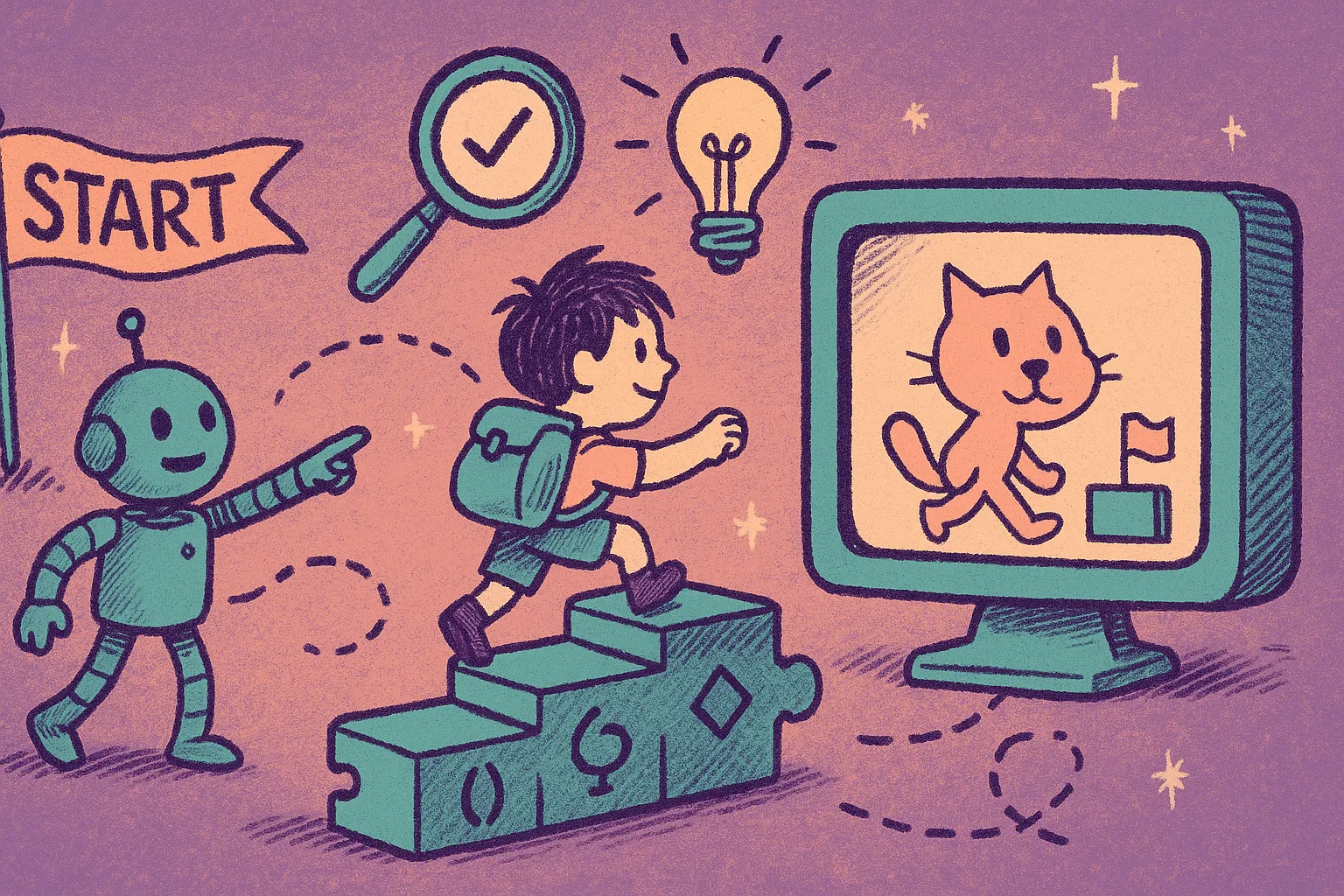
- Low floor, high ceiling: Kids can build something fun in minutes, yet grow to complex games.
- Right kind of challenge: Blocks remove syntax errors so children can focus on logic and problem-solving.
- Stronger transfer later: After a short Scratch phase, moving to Python/Roblox is smoother and faster.
The Big Idea: Master the Logic First
When children begin coding, the goal isn’t to memorise language rules—it’s to think like a problem-solver. Scratch lets them practise sequencing, loops, events, variables and debugging without fighting punctuation or cryptic errors. That early momentum builds confidence, and confident learners stick with it.
We’ve seen it repeatedly in class: 20 minutes in Scratch beats 1 hour wrestling with a missing bracket.
Why Scratch Works for 6–12 Year Olds
1) Immediate feedback = motivation
Drag, snap, press the green flag—it runs. Children see cause-and-effect instantly, which is motivating and makes it easier to explain their thinking.
2) Reduces cognitive load (fewer “gotchas”)
Block shapes prevent most syntax mistakes. That frees up brainspace for logic, planning, and debugging strategies—the bits that truly transfer to typed languages.
3) Event-driven thinking (real software patterns)
Scratch’s “when key pressed/when sprite clicked” maps directly to input events in Python games, Roblox scripts, and even web apps later on.
4) Creativity hooks learning
Kids invent characters, sounds and stories. That creativity keeps them engaged long enough to learn loops, conditions, variables and functions properly.
5) Teamwork and communication
Projects are visual. Children can show what a bug looks like, discuss fixes, and learn to break tasks into smaller chunks—core skills in any language.
“But Isn’t Block Coding Too Simple?”
Short answer: No—it’s the right kind of simple.
- Simple to start, not simplistic overall. We introduce real concepts early: state, collision, timers, randomisation, and basic AI (e.g., chasing enemies).
- Complexity scales up. We gradually add multiple sprites, health systems, scoring, levels, and custom blocks (functions) with parameters.
What We Teach in the First Few Weeks (Example)
While every student moves at their own pace, a typical Scratch learning journey often follows this plan:
- Week 1–3: Foundations
Simple events, motion, forever loops, variables, and basic sounds.
Example: Build Catch the Cat, where a cat constantly darts around the scene and shrinks/jumps to a new random spot when clicked — each successful click earns the player a point. - Week 4–12: Game Logic
Conditionals (if/else), event propagation and handling, sprite interactions, background transitions, clones (spawning), and simple start/play/game-over states.
Example: Build a maze game, where the player steers a sprite with arrow keys along a valid path; if it touches a wall colour the move is blocked (the sprite bounces), and reaching the goal unlocks the next map. - Week 12+: Structure & Reuse
Custom blocks (functions) for reusing code and organising larger projects.
Mini-goal: Create a mini platformer game with basic physics like gravity, collision with map elements, and smooth controls — move with the arrow keys and jump with the space bar.
By this stage, most students can explain why their code works, not just that it works. That’s the green light to start blending in text-based coding, such as Python or HTML/CSS/JavaScript.
When Do We Move Beyond Scratch?
We transition as soon as a student shows these readiness signs:
Readiness checklist:
- Can break a feature into clear steps and test them one by one
- Uses variables, loops, and conditions without prompting
- Can find and fix a simple bug independently
- Explains their game logic in their own words
- (Nice to have) Uses custom blocks to tidy repeated code
Next steps we offer:
- Python: Logic puzzles, tiny text games, then Pygame Zero for graphics.
- Roblox Studio: Lua scripting attached to objects and events, using the same thinking learned in Scratch.
- Minecraft Modding: Rule-based logic first, then code-driven behaviours.
- Web Programming: HTML for structure, CSS for styling, and JavaScript for interactivity — building fun mini websites and simple browser games.
What Transfers from Scratch to “Real Code”?
- Concepts: sequence → loops → conditionals → variables → functions
- Practices: planning, testing, debugging, incremental design
- Mindset: confidence, curiosity, resilience when things break
Once these are settled, typingif,while, andfunctionis the easy bit.
Common Parent Questions
Q: Won’t my child get bored with blocks?
A: Not at all. We raise the challenge quickly: adding levels, enemies, power-ups, timers, and trickier logic. Once the basics are second nature, kids stay engaged because they’re building their own ideas.
Q: Will starting with Scratch delay “real programming”?
A: Quite the opposite. A solid term in Scratch often saves months of frustration later in Python or any other programming languages. Kids learn problem-solving and logic first—so when they move on, the syntax is the only new hurdle.
Q: My child is 8 and eager—can we skip straight to Python?
A: Sometimes, yes. If they tick the readiness boxes above—or already have Scratch-equivalent experience—we’ll place them at the right starting point.
The Bottom Line
We start with Scratch to build thinking skills, not just typing skills. Once the mindset and core concepts are in place, students leap into Python, Roblox or Minecraft with confidence—and make faster, cleaner progress.
Ready to see it in action?
Book a Trial at Skill Samurai Lane Cove—friendly coaches, small groups, and a clear path from Scratch to Python/Roblox.
